
#34: Cascadia

BIOREGION
Cascadia, a region found on the western coast of the United States and Canada, and somewhat synonymous with the Pacific Northwest, is the topic of today’s blog post. We’re going to explore the bioregion, the movement for independence, and the culture of this region.
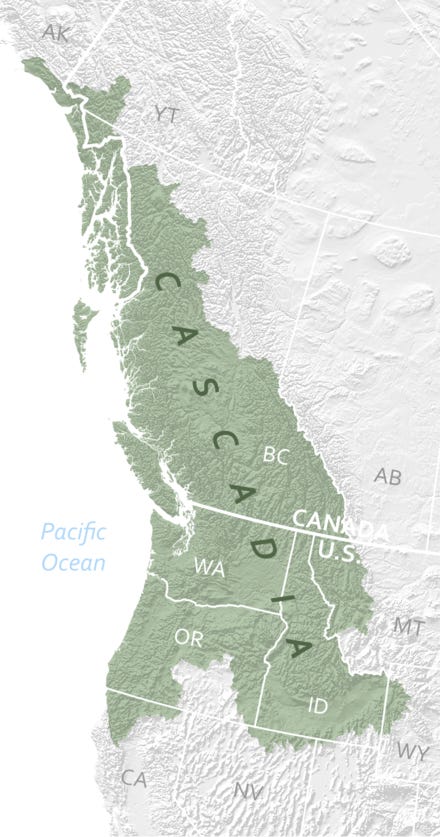
This region is stretched across the American states of California, Oregon, and Washington and accompanied by the Canadian province of British Columbia; more expansive interpretations of the region also include other states/provinces such as Idaho, southern Alaska, and south-west Alberta. In an expansive point of view, Cascadia’s northern-most point would be the town of Ketchikan in Alaska, the southern-most point would be San Francisco of California, and the eastern-most point would be the town of Canmore in Alberta. The region hugs the Pacific Ocean’s eastern border with North America, and is characterised by the verdant forests stretching between the coastline and the Rockies mountain range’s western edge. It is home to the iconic Douglas fir tree, which features on the secessionist movement’s flag. The roughly central point of this region is the Olympic peninsula, and the Olympic National Park best represents the nature of the region: dense rain forests where trees never lose their leaves, where grey clouds are commonplace.
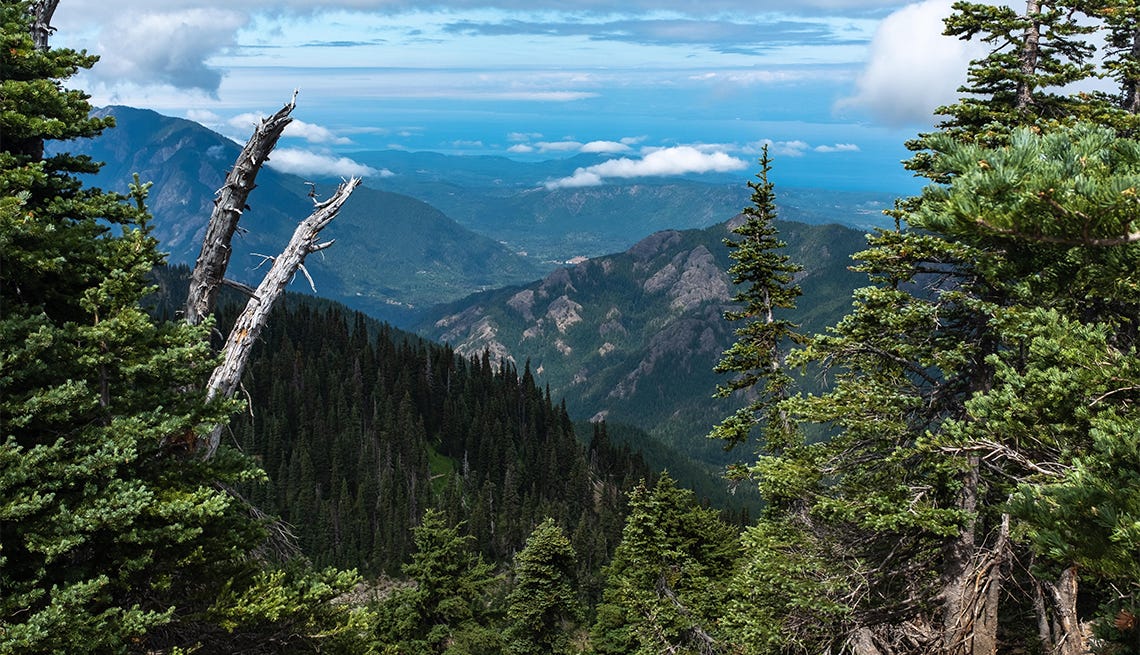
The name for this region is quite new; “Cascadia” was first applied to this area by Bates McKee in a geology textbook from 1972 called Cascadia: the geologic evolution of the Pacific Northwest. A sociology professor from Seattle University by the name of David McCloskey describes Cascadia as “a land of falling waters”. Cascadia as an independent nation would be roughly the same size of Peru or Mongolia, would have a population similar to the Netherlands or Ecuador, and would have a GDP per capita roughly equal to Denmark. All in all, a pretty good hypothetical place to live!
SEPARATION MOVEMENT
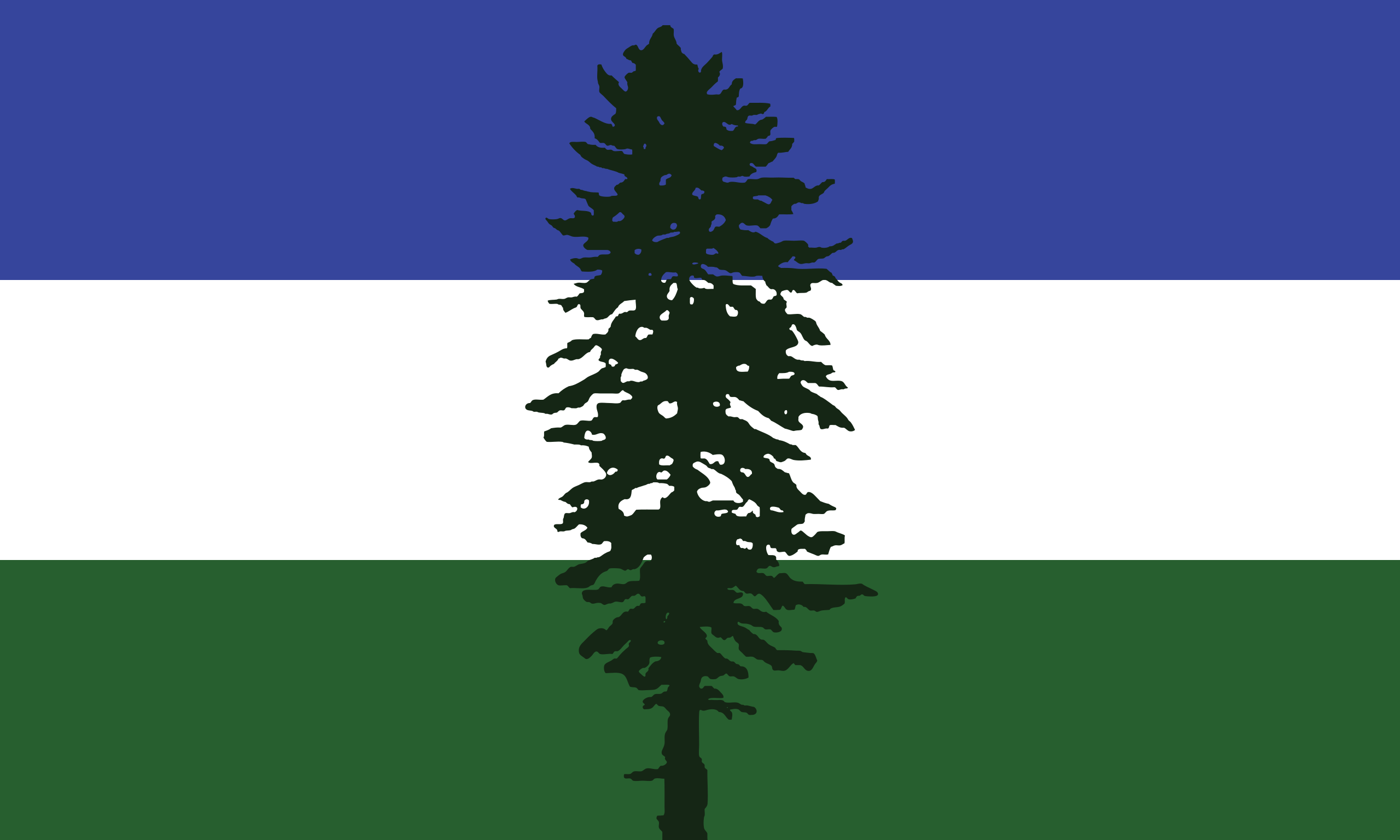
The movement for Cascadian independence is found across a number of groups, there is no one standard bearer - the movement is very much “grassroots”. If there is a focal point, it is the “Doug flag”: a tricolour of dark green, ocean, blue, and white, with a image of a Douglas fir firmly planted in the middle. As with any grassroots movement, the reasons for joining are varied; environmentalism, civil liberties & rights, an alternative to a nation-state, local food & culture - each of these are listed as reasons why one would want to join up with such a crew of mild & polite activists. It must be said that the movement is peaceful and not quite serious; in none of the states or provinces is the issue widely discussed outside of specifically commissioned surveys. However, if anyone is going to start a widespread debate, it appears the people of British Columbia will be at the forefront: in 2020, a survey found that amongst all age groups of BeeCers support for a discussion around becoming independent from Canada had grown, with the lowest rate of growth from previous surveys (standing at 18% growth) found in the “55 & over” age bracket. When BeeCers look for the state or province that they feel most similar to, 72% of respondents looked south to the Pacific states of Washington (54% overall) and California (18% overall) - one must feel for the Oregonians, I imagine they feel left out. 15% of those BeeCers felt that their eastern neighbours & fellow Canadians in Alberta were most similar to them, but as a current resident of Alberta, I can’t say that the people of the prairies here would feel any kind of disappointment at running 3rd in the competition of “who do BeeCers like the most?”.
REGIONAL LINKS
What are the defining links of this region? Well, the economic links of the two largest cities of the region - Seattle of WA and Vancouver of BC - are central. Being only a 3hr drive apart; one can easily see the two cities begin to morph into one cross-border megalopolis in the decades to come. The Pacific Coast Collaborative organisation, with the members being California, Oregon, Washington and British Columbia, work together in areas of environmental, fishery, and emergency preparedness policy. As mentioned earlier, BeeCers find themselves in common with Washingtonians, and it isn’t difficult to imagine that Washingtonians, Oregonians, and Californians see themselves with more similarities to their Canadian cousins across the border than their fellow Americans in Florida, Tennessee, or Oklahoma. Just as the Gulf States of the USA feel an affinity with each other, so do these 4+ states/provinces. Perhaps the prevalence of marijuana, craft brew beer, specialty roasted coffee, and Patagonia vests plays a role in that affinity? In a world of large nation-states which somewhat disregard regional differences, those regions will take steps to promote not only their own interests but also their own sense of belonging and community. The biological and cultural region of Cascadia is an example of this, but perhaps the Catalonian community in Spain or the Quebecois are the best examples of regions pushing for recognition.
It leads to a wider point about Canada; while many things unite them (love of hockey, dealing with snow, Tim Hortons, a subdued but always-burning dislike of Toronto), the Great White North is especially the first - great. The size of this country lends itself to different cultures and identities (such as the Metis peoples of the Prairies) popping up all over the place. In fact, it doesn’t take much effort to find a separatist movement in many (if not all) of the Canadian provinces. Quebec is obvious, we’ve just discussed the Britich Columbia movement, but in the eastern Maritime provinces the “Acadian” movement exists, Saskatchewan has some residents who favour the “Western Canada” idea, Alberta has the Wildrose independence movement, Newfoundland & Labrador sees itself as forming a nation on its own - there is a lot of people who are a bit put out at being a part of such a big union (there’s event a Wikipedia article for Western Canada’s disillusionment: https://en.wikipedia.org/wiki/Western_alienation). To wrap this post up, I’ll turn to a turn-of-phrase I picked up somewhere: “Is Canada a country or just a bunch of regions which tolerate each other?” Something to ponder in the week ahead!